Politics
The Colorado River Basin in the 19th Century
The United States in the 19th Century was a rapidly-expanding country, extending its borders West as part of the idea of "Manifest Destiny", the idea that the United States had a God-given right to expand its borders from the Atlantic to the Pacific.
The gradual incorporation of territories gained from the annexation of Texas and the Mexican Cession in 1848, would see incremental borders drawn along straightedges without a clear understanding of what resources lay in these new jurisdictions.
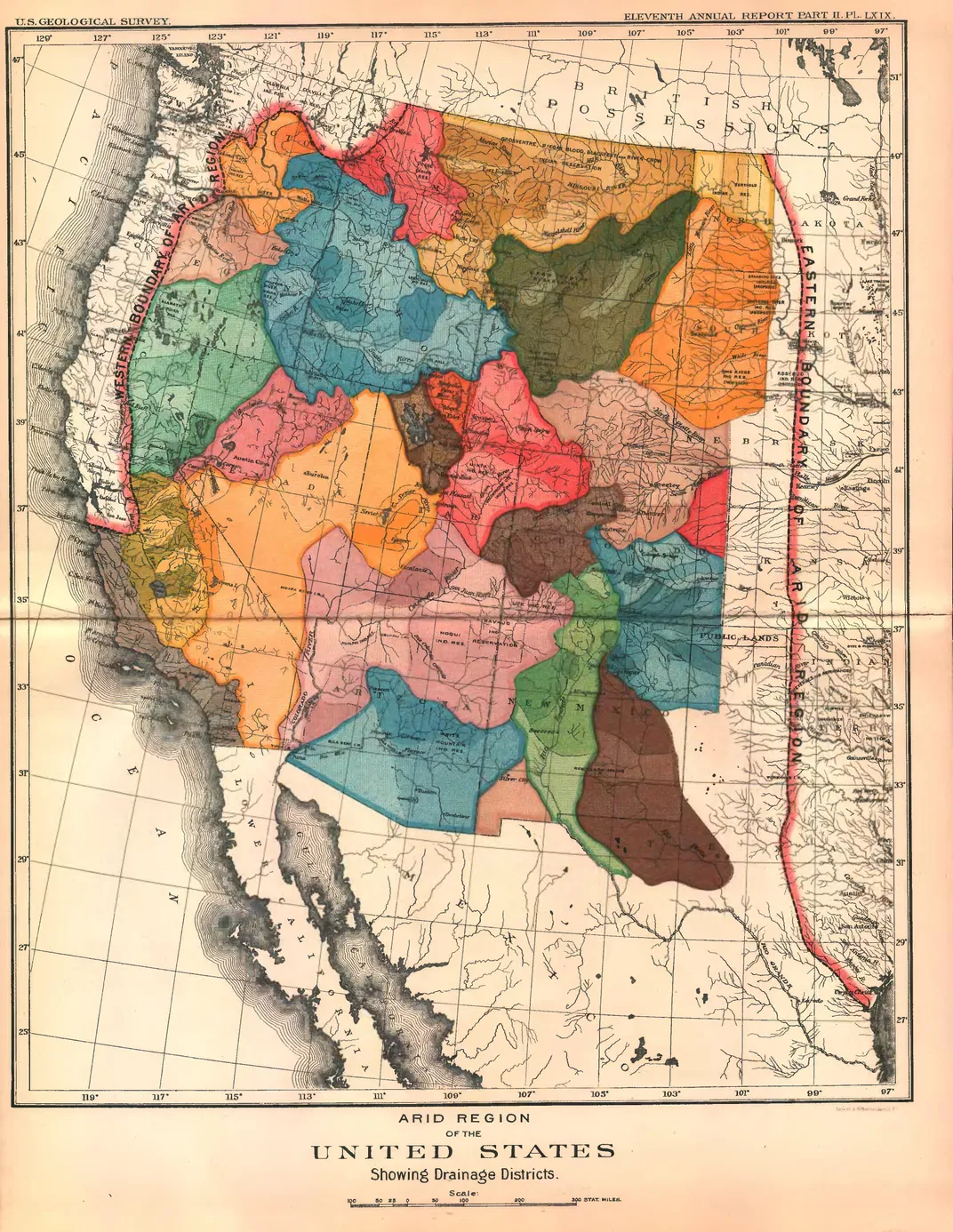
The first meaningful American efforts to survey and understand the land and resources of the Colorado River would be pursued by Major John Wesley Powell starting in the late 1860s, and concluded in 1875 with a book which would eventually be revised and titled The Exploration of the Colorado River and Its Canyons.
Now, senators hailing from western states by this time were trying to market their home states as ideal spaces for settler migration--and they recruited Powell to support their narrative. However, Powell would contest this narrative, bringing a map (see left) to explain the watersheds of the Arid Region.
Powell's map clearly exemplifies his argument: the hydrology of watersheds spanning across the Arid Region follow an entirely different logic than the straightedge borders of the West--and that conflict was something he understood as a long-term problem for the stability of this region.
He wasn't very popular with the senators, and his arguments about the delicacy of the West's natural resources were lost on their ears. John Wesley Powell and his warnings would remain an ominous premonition of what was to come in the next hundred-twenty years.
The Colorado River Basin Today
In the present day, 35 to 40 million people rely on water from the Colorado River. At the bare minimum, one-in-ten Americans rely on the river to meet their everyday water needs, whether it be for agriculture, hydroelectric power, or even plain drinking water.
Yet this environment is at risk. The Colorado River relies on runoff from Rocky Mountain Snow as a source of water which replenishes the river over time. The 2025-2026 winter season, however, has recorded a historic low for liquid water storage in Colorado's snowpacks, reflecting a trend of