Did you know? The Colorado River basin is a hydrologic system which sustains 35-40 million people? At the bare minimum, one-in-ten Americans rely on the Colorado River to meet their everyday needs, whether it be agriculture, hydroelectric power, or ordinary drinking water.

Yet this environment is at risk. The Colorado River relies heavily on snow from the Rocky mountains as a source of water which would replenish the river over time. Yet Climatologists measuring snowfall from the 2025-2026 winter season have recorded historic lows for liquid water storage in Colorado’s snowpacks. This will continue to contribute to a decreased water supply, the declining health of the Colorado River basin as an ecosystem and the well-being of millions of people living within its watershed.
The image on the right is of Lake Mead, and the white rock is where the water level was long ago. And while states are fighting to preserve their piece of the Colorado River in 2026, this water will only become more scarce over time. This trend isn’t just concerning—it implicates other reservoirs such as Lake Powell, which has reached record-low levels. It’s gotten to the point that hydropower for the Lower Colorado River basin is now in danger, costing valuable electricity for the region. And while they certainly need more water in their lakes, states in the Upper Colorado River basin are also having a hard time with supply, so this isn't necessarily something that can be resolved with extra releases of water, which may lead to conflict if water increases in scarcity.
In the modern day, states are frantically seeking to resolve this crisis on the Colorado River. Yet this crisis isn’t something that can be so easily resolved with handshake deals. Rather, it is the consequence of the straight-edge border drawing of the 19th century which failed to account or adapt to the ecological circumstances of the American West.
The 19th Century is a time infamously dominated by “Manifest Destiny”, or the idea the United States had a God-given right and duty to extend its duties from the Atlantic to the Pacific. The acquisition of territories through conquest in the years building up to the American Civil War led to a situation where the United States had doubled its size without truly understanding what the makeup of resources in these new jurisdictions truly were.
The Colorado River Basin in the 19th Century
The first meaningful American efforts to survey and understand the land and resources of the Colorado River would be pursued by Major John Wesley Powell starting in the late 1860s, and concluded in 1875 with a book which would eventually be revised and titled The Exploration of the Colorado River and Its Canyons. In this time, Powell surveyed the land, navigated the rivers, and ultimately mapped out hydrologic zones in the Arid Region of the United States.
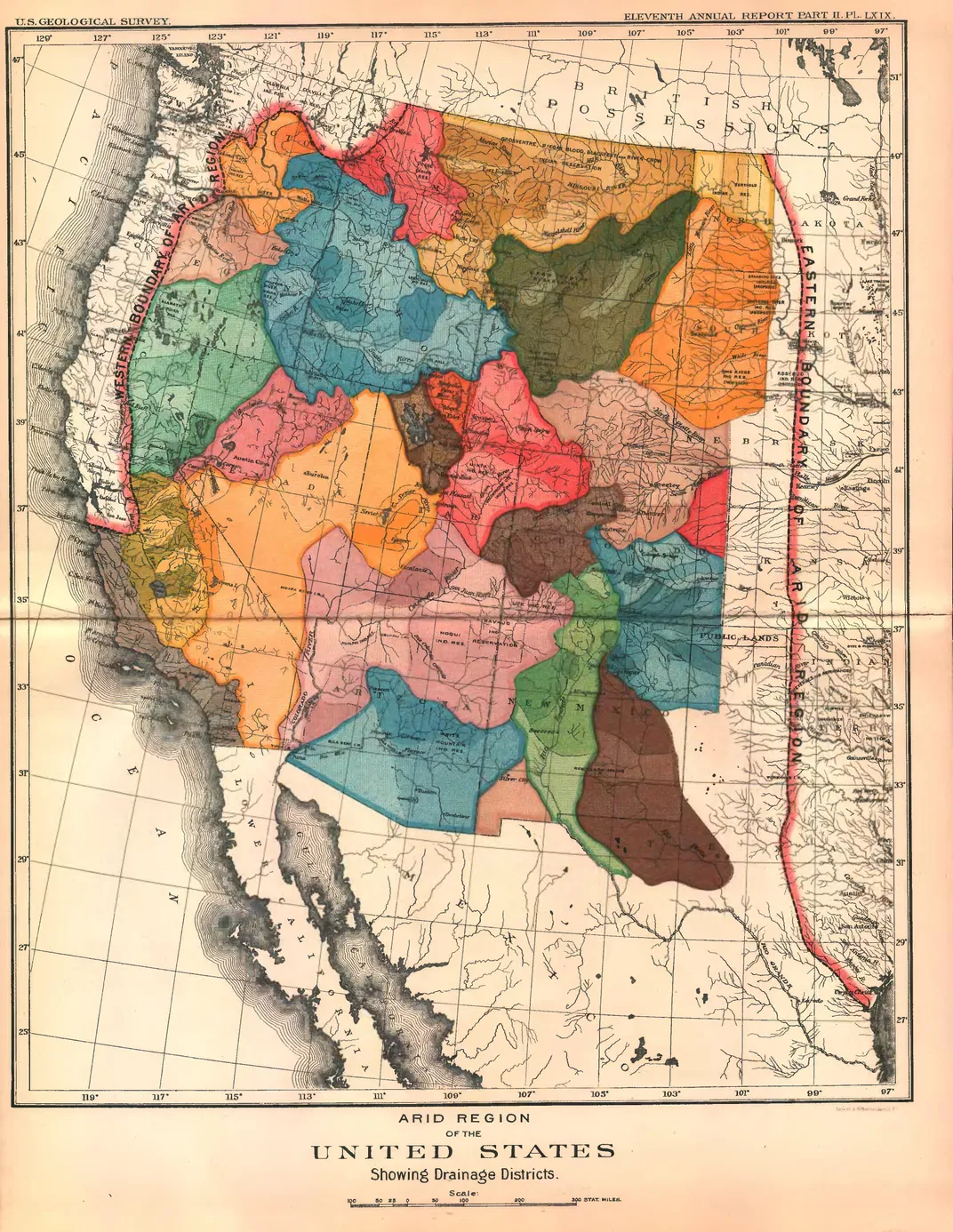
At the same time, senators on the Senate Select Committee on Irrigation and Reclamation of Arid Lands were trying to market their home states in the West as ideal spaces for settler migration—and they saw Powell (who was head of the U.S. Geological Survey (USGS) by this point) as the United States’ leading expert on the area who could support their narrative that irrigation projects could transform the Arid Region into a new Eden.
Powell disagreed. With him, Powell brought a map to explain: the watersheds of the Arid Region were delicate ecosystems which weren’t necessarily sustainable for expansion due to variables such as low precipitation. Furthermore, the watersheds spanning across this region followed an entirely different logic than the straightedge borders of the West. This couldn’t be ignored in understanding the Western United States, as it was only going to grow into a long-term problem for the stability of this region.
If you couldn’t tell, John Wesley Powell wasn't very popular with the senators. His arguments about the delicacy of the West's natural resources were lost on their ears, and they proceeded without acknowledging his advice. Powell and his warnings would instead remain an ominous premonition of what was to come in the next hundred-twenty years.